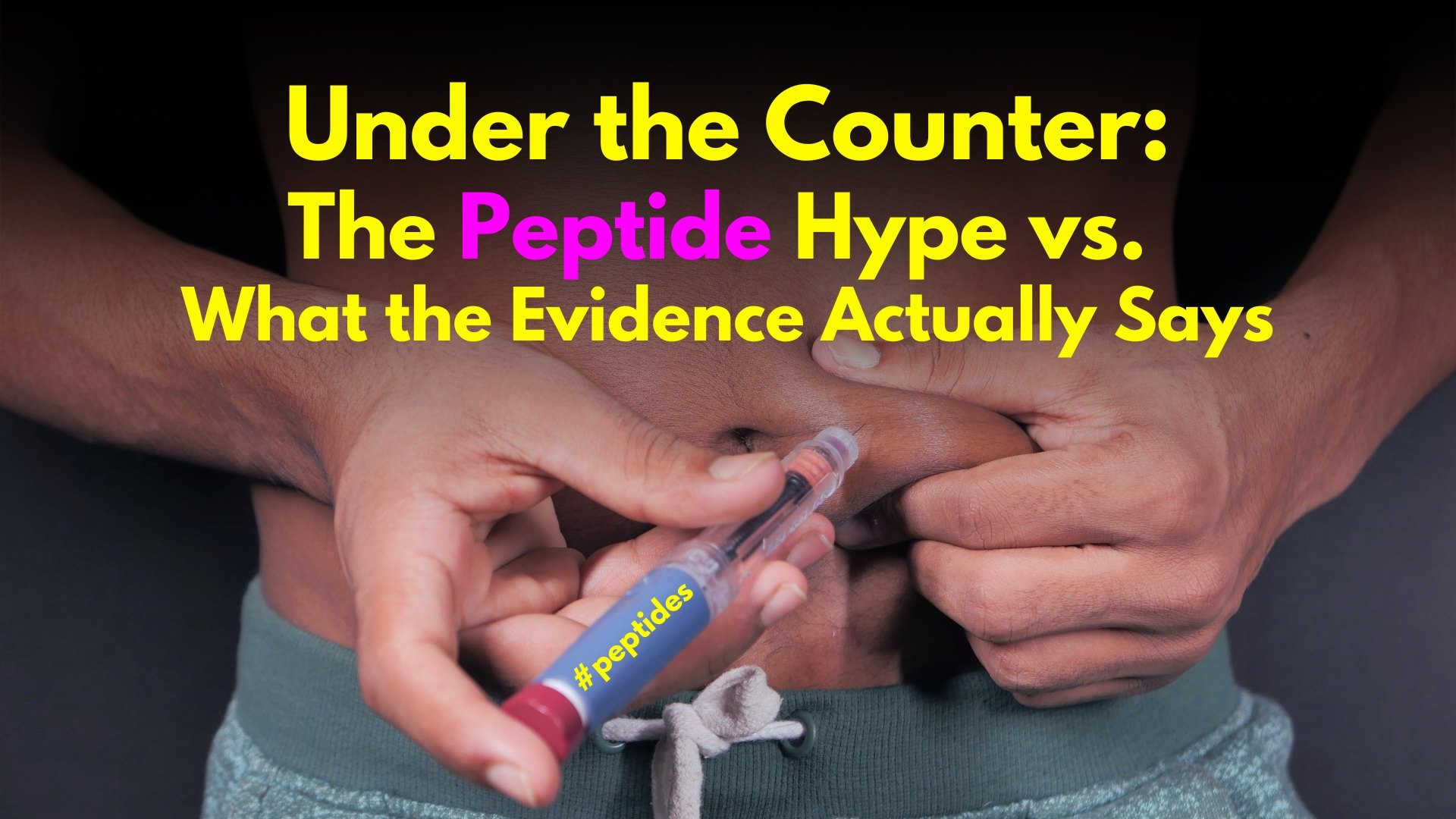

Under the Counter: The Peptide Hype vs. What the Evidence Actually Says
In this Nexus:
- 📍 What is a peptide?
- 🔥 The biohacking hype machine and the “for research purposes only” loophole
- ⚗️ What Does Science Say? A peptide-by-peptide reality check
- 🧬 Peptides and longevity: an experiment running in real time
- 🏛️ The FDA discussion happening now
- ✅ My own perspective
- 💡 How to think about peptides without becoming the experiment
Last month, after a lecture that I gave on longevity and healthy living, a woman came up to me and asked what I think about peptides. And no, not the ones registered as medicines. The ones you can now get from under the counter and inject at home. My opinion was of course grounded in scientific evidence, so it fitted into three words:
Untested. Unregistered. (Therefore) unsafe.
I watched the disappointment spread across her face. She looked like she didn’t even want to continue the conversation. And I would almost guarantee that she is going to inject those unregulated peptides anyway. Because on social media today, peptides are sold as something close to a miracle. They “rejuvenate”. They “melt fat”. They “build muscle”. They “fix your sleep”. They “restore the whole organism”. They “slow aging”. That is a powerful pitch, and it is running far ahead of the evidence. So I dedicate this Nexus edition to explaining the science (or the lack of it) behind the hype.
What is a peptide?
A peptide is, at its core, a short chain of amino acids that can act on the body as a biological signal. In human language: these are molecules capable of switching on very specific systems in our body – hormone release, inflammatory processes, cellular growth, appetite, metabolism.
And that is exactly why this is not “innocent biohacking” or a harmless “beauty and youth boost”. A molecule that can flip biological switches is, by definition, a molecule that can flip them in the wrong direction too. People inject peptides for athletic performance, weight loss, energy, skin, and the promise of a longer life. The justification is usually a single study in mice, a cell culture, or a very small group of humans with no comparison group.
The biohacking hype machine
Here is the part the influencer clips leave out. Many of the “longevity” peptides being sold today are not registered as medicines at all. That means nobody has really tested or controlled their quality, purity, potency, or safety. The person injecting often does not know what exactly is in the vial, what the true concentration or dose is, whether there are impurities, or even whether it is the substance printed on the label.
Some of these products are sold with a tidy legal disclaimer – “for research purposes only” – and then used on humans anyway. This is the wild wild West, and the buyer is both the researcher and the lab rat at the same time.
The paradox that fascinates me most: the same people who inject unregistered peptides are often the ones most afraid of “chemicals”, of medicines, of vaccines – the very products that went through years of safety and efficacy testing. Real therapy should not rest on “it helped someone” or “look at her, she injects it and looks great”. It should rest on quality evidence, risk assessment, and long-term data.
What Does Science Say?
Here is a rundown of the most popular unregistered peptides:
💉 BPC-157 is probably the internet’s most popular “heals everything” peptide – tendon healing, joint regeneration, muscle recovery, gut disease. Now the facts. In 2015, a Phase I clinical trial was registered (NCT02637284), planning to enroll 42 healthy volunteers. It was terminated, and results were never published. A 2025 review concluded that essentially the entire BPC-157 evidence base rests on animal studies, with no quality randomized controlled trials in humans.
💉 TB-500 is another peptide credited online with near-magical regenerative powers. Yet even the most recent reviews conclude that human clinical data are practically nonexistent, and most claims rest on preclinical experiments in animals and cells.
💉 GHK-Cu (Copper Tripeptide-1) is a slightly different case. There is a reasonable body of preclinical and small clinical work showing benefits for skin regeneration, wound healing, and collagen synthesis – which is why it is widely used in cosmetics. But when the conversation turns to subcutaneous injections, longevity, or whole-body “rejuvenation”, the large randomized trials simply do not exist. The data support topical benefit for skin, not the systemic effects promised online.
💉 CJC-1295 is where it gets more interesting. A 2006 study showed it raised blood concentrations of growth hormone and IGF-1 – but it was small and measured hormonal changes, not clinical benefit. A later Phase II trial in patients with HIV-associated lipodystrophy was halted after one participant died. A direct causal link was never established, but the entire clinical program was stopped and the drug never reached registration. Today it is marketed as an almost routine anti-aging tool.
💉 Ipamorelin is usually stacked with CJC-1295. Most of the data show only a biological effect – stimulation of growth hormone secretion. After more than two decades, we still have no large Phase III trials showing that it meaningfully builds muscle, improves health, or slows aging in healthy people.
💉 MOTS-c is one of the darlings of the longevity community. The problem is simple: most of the excitement grew out of experiments in mice. When you go looking for human clinical trials, you suddenly find very few.
💉 AOD-9604 is one of the best examples of why “if there are studies, it must work” is a dangerous shortcut. Six randomized, double-blind, placebo-controlled trials were conducted, enrolling more than 900 patients. The result? No statistically significant, dose-dependent weight-loss effect – and its development as an obesity treatment was discontinued.
💉 Melanotan II is one of the few unregistered peptides that has already accumulated a real catalog of adverse reactions: nausea, vomiting, facial flushing, priapism, kidney injury, and other complications. It comes up often when experts discuss the risks of illegally used peptides.
FDA discussion
When I first wrote about peptides, the most common argument from promoters was – wait until July and the FDA will approve all peptides. Well, not quite. On 29 September 2023, the FDA placed 19 bulk substances into “Category 2” of its interim compounding policy – the category for substances that may present significant safety risks and therefore may not be used in pharmacy compounding.
The list reads like a screenshot of a biohacking forum: BPC-157, CJC-1295, ipamorelin, AOD-9604, MOTS-c, melanotan II, TB-500, epitalon, semax, KPV, kisspeptin-10, ibutamoren, and others. Two details matter. First, GHK-Cu was split: Category 2 for injectable routes, Category 1 for everything else – the regulator drew exactly the topical-versus-injected line. Second: none of these peptides had ever been in Category 1. The 2023 action did not revoke a permission; it made an existing prohibition explicit.
At the Pharmacy Compounding Advisory Committee meetings in late 2024, not a single peptide got a favourable recommendation. Then, in April 2026, the FDA removed twelve peptides from Category 2 – and the internet promptly declared victory. Read the actual notice: they were removed because the nominations were withdrawn by the parties who submitted them, not because of any new safety finding. Removal from Category 2 is not approval. The FDA’s safety assessments for every one of these peptides are still published on its website today.
One more correction. You will read that “the FDA reclassified peptides as biologics”. That is not what happened to these molecules. The 2020 rule defining a “biological product” set the threshold at more than 40 amino acids. BPC-157 is 15 amino acids, MOTS-c is 16, the TB-500 fragment is 7, KPV is 3. Under that rule they all remain drugs, not biologics. Their exclusion from compounding rests on the safety determination, not on a definitional technicality.
Peptides and longevity: an experiment in real time
Part of the community behaves as though the effectiveness of these compounds were already proven. But open the scientific literature or the clinical-trials database, and a very different picture appears: a study in a cell culture; a study in mice; a Phase I trial in a few dozen volunteers; a halted clinical program; completed trials whose results were never published; a compound tested but never registered because it lacked efficacy.
None of this means these peptides definitely do not work. It means we do not know whether they work well enough and safely enough to be used like medicines. In medicine, the distance between “might work” and “proven to work and proven to be safe” is enormous. That gap is the whole reason clinical trials, registration, and drug surveillance exist. With many of today’s fashionable peptides, what is really happening is a live human experiment – in real time, with volunteers who did not fully consent to being subjects.
My perspective
I keep coming back to that woman’s face after my lecture. The disappointment was real, and I understand it – she wanted permission, not a caution. That is the hardest part of communicating longevity science honestly: sometimes the evidence-based answer is the one nobody wants to hear.
And I will be honest about my own position: I am genuinely open to peptide therapeutics. Some registered peptide medicines are among the most effective tools we have. But “I am open to the science” and “I will inject an unlabeled vial bought online through a Telegram group” are not the same sentence. When I want to know something about my own biology, I test it – biomarkers, not vibes. Show me the human data, the dose, and the safety profile, and then we can talk.
How to think about peptides without becoming the experiment
- Separate registered from unregistered. Insulin and semaglutide are peptides too, and they are medicines precisely because they passed the trials. That is the category you want to be in.
- Ask for the human data, not the mouse data. “It worked in animals” is a hypothesis, not a result. If the strongest evidence is preclinical, treat the claim as unproven.
- Distrust the “for research purposes only” label. If it is legally not for human use, that is not a loophole – that is the warning.
- Remember you cannot see purity or dose. With unregulated vials, you do not actually know what, or how much, you are injecting.
- Weigh the paradox honestly. If you are wary of tested medicines and vaccines, an untested injectable should terrify you far more.
Any therapy should be built on quality evidence, risk assessment, and long-term data – not on “it helped someone” or “look how good she looks”. That is not gatekeeping. That is the difference between a patient and a subject.
Hope you enjoyed the read. More on longevity and healthspan is coming soon. I have a feeling this one will spark a few messages – make sure to subscribe and share your thoughts.
Selected references
- ClinicalTrials.gov. NCT02637284 – Phase I study of PCO-02 (BPC-157) in healthy volunteers.
- Vasireddi N, et al. Emerging Use of BPC-157 in Orthopaedic Sports Medicine: A Systematic Review. HSS J. 2025.
- McGuire F, et al. Thymosin Beta-4 and TB-500 in Tissue Healing: A Scoping Review. Appl Sci. 2026.
- Pickart L, Margolina A. Regenerative and Protective Actions of the GHK-Cu Peptide. Int J Mol Sci. 2018.
- Teichman SL, et al. Prolonged stimulation of GH and IGF-I by CJC-1295 in healthy adults. J Clin Endocrinol Metab. 2006.
- Bernard EJ. Lipodystrophy study halted after patient death. aidsmap/NAM, 2006.
- Beck DE, et al. Ipamorelin for postoperative ileus: proof-of-concept study. Int J Colorectal Dis. 2014.
- Mohtashami Z, et al. MOTS-c in Human Aging and Age-Related Diseases. Int J Mol Sci. 2022.
- Stier H, et al. Safety and Tolerability of AOD9604 in Humans. J Endocrinol Metab. 2013.
- Nelson ME, et al. Melanotan II injection resulting in systemic toxicity and rhabdomyolysis. Clin Toxicol. 2012.
- U.S. FDA. Certain Bulk Drug Substances for Use in Compounding That May Present Significant Safety Risks (current as of 22 April 2026).
- U.S. FDA. Pharmacy Compounding Advisory Committee Summary Minutes, 29 Oct 2024 & 4 Dec 2024.
- Definition of the Term “Biological Product”. Final rule. Fed Regist. 2020;85(34):10057–10066.
Subscribe to NexusPrenumeruokite „Nexus“
The science of living longer and better – in your inbox. Free, evidence-based, no spam.Mokslas apie ilgesnį ir geresnį gyvenimą – jūsų pašto dėžutėje. Nemokamai, pagrįsta įrodymais, be šlamšto.