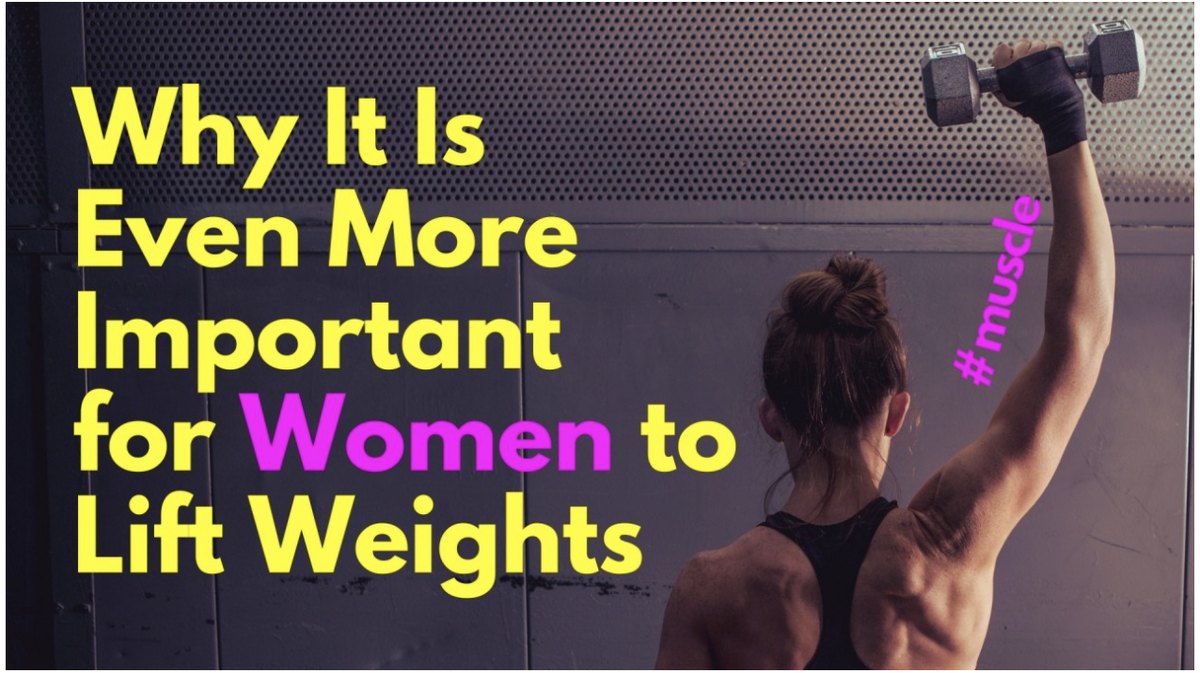

Why It Is Even More Important for Women to Lift Weights
In this Nexus:
- 💪 Muscle as the longevity organ – why it matters more than you think
- 📉 How and why we lose muscle with age (and why women have it worse)
- 🦴 Perimenopause, osteoporosis, and the bone density crisis
- ⚗️ What Does Science Say? Clinical trial data on muscle mass and all-cause mortality
- 🏋️ My Personal Experience With Strength Training
- ✅ How to start lifting: practical tips for complete beginners to more advanced lifters
Here is a scene I bet you have lived or seen. A woman is walking out of a shopping mall. She has a 15 kg toddler in her hands balanced on one hip. The other hand is carrying two grocery bags that together weigh another 8 kilos. She is navigating revolving doors, escalators, and a packed car park without breaking a sweat. She didn’t think twice about it. Now tell me again that weightlifting is not for women?
That is the thing. Women lift heavy things every single day. They carry children, haul pushchairs up flights of stairs, lift boxes, carry suitcases, and hold the world together quite literally. The idea that the gym barbell is somehow not “feminine” is one of the most persistent and damaging myths in women’s health. It has kept women on the treadmill and away from the weights rack for decades, and the health consequences are real.
In this edition of the Nexus Newsletter, I want to make a strong, evidence-based case for why strength training is not just good for women, it is arguably MORE important for women than for men, especially as we age. I will walk you through the muscle biology, the menopause connection, the bone density data, the mortality statistics, and give you practical steps to start wherever you are right now.
Muscle Is Your Longevity Organ
We talk a lot in longevity circles about the heart, the brain, the gut microbiome. We measure our VO₂ max, track our sleep, obsess over our omega-3 index (guilty myself). But there is one organ that does not get nearly enough credit: skeletal muscle.
Muscle is not just for lifting things or looking good. It is metabolically active tissue that performs critical systemic functions:
- It regulates glucose. Skeletal muscle is responsible for approximately 80% of insulin-stimulated glucose uptake. In human language – your muscles are the primary consumers of blood sugar after a meal. Less muscle = worse glucose control = higher type 2 diabetes risk.
- It produces myokines. When you exercise muscle, it releases small signalling molecules called myokines (sometimes called “hope molecules”) that have anti-inflammatory, neuroprotective, and anti-cancer effects throughout the body. Your muscles talk to your brain, your immune system, and your metabolism every time you lift something heavy.
- It is your metabolic reserve. In illness, surgery, hospitalisation, or chronic disease, the body draws on muscle protein for fuel and repair. People with more muscle mass survive critical illness at higher rates and recover faster.
- It protects your joints and bones. Strong muscles are the scaffolding that holds your skeleton together and absorbs mechanical stress so your joints don’t have to.
The scientist Dr. Gabrielle Lyon has described skeletal muscle as “the organ of longevity”, and I cannot agree more. In such a way of thinking, sarcopenia, the progressive loss of muscle mass and strength with age, is one of the most underappreciated health crises of our time.
The Muscle Decline Clock Starts Earlier Than You Think
Here is the uncomfortable truth: muscle loss begins in your 30s. Research consistently shows that skeletal muscle mass decreases approximately 3–8% per decade after the age of 30 (1). This sounds manageable, until you hit your 50s and 60s, when the rate of decline accelerates significantly. After the age of 60, losses of up to 15% per decade have been documented (1). By the eighth decade of life, some people have lost up to 50% of the muscle mass they had in their 30s.

World weightlifting records, which serve as a useful proxy for peak human strength, decline by over 50% in women between the ages of 30 and 60 (2). Fifty percent. In three decades. That is not a gentle fade, that is a cliff.
The clinical term for significant age-related muscle loss is sarcopenia (from the Greek sarx = flesh, penia = poverty). It is characterized by low muscle mass, low muscle strength, and poor physical performance. It used to be considered an inevitable part of aging. We now know that is not true, and the interventions that prevent it are well understood. The most powerful one is resistance training.
Perimenopause, Menopause, and the Bone Density Crisis
Let me take you to a specific moment in a woman’s biological life: perimenopause. This is the transition period, typically beginning in the mid-40s, sometimes earlier, when oestrogen levels start fluctuating and declining on their way to menopause.

Oestrogen is not just a reproductive hormone. It plays a critical role in bone metabolism. It inhibits osteoclasts, the cells that break bone down, and supports the balance between bone formation and resorption. When oestrogen drops, this balance shifts. Bone is broken down faster than it is built, and bone mineral density (BMD) declines.
In the first 5–7 years after menopause, women can lose 2–3% of bone mineral density per year (3). Over a decade, that can add up to a 20–30% reduction.
1 in 2 women over 50 will experience an osteoporosis-related fracture in their lifetime (4), compared to 1 in 5 men.
A hip fracture in older age is not just painful, it is genuinely life-threatening. Up to 30% of older adults who suffer a hip fracture die within one year (5). I do not share this to frighten you. I share it because it is reversible, preventable, and deeply underappreciated.
Now here is the important part: resistance training stimulates bone formation. When you load your skeleton through lifting weights, jumping, or impact exercise, you signal to your bone cells (osteoblasts) to lay down new bone tissue. This is called Wolff’s Law. Bone adapts to the mechanical forces placed upon it, and the clinical trial evidence on this is strong.
What Does Science Say?
Sarcopenia and All-Cause Mortality
A large meta-analysis synthesising data from 39 studies and over 76,000 participants found that sarcopenia was associated with a 79% higher risk of all-cause mortality (6). That is in the territory of well-established cardiovascular risk factors. Looking specifically at women, low muscle mass was associated with a 54% higher risk of death (6).
A 2024 prospective cohort study drawing on data from 28 countries confirmed that lower muscle strength in the oldest adults was strongly and independently associated with all-cause mortality (7). Even among centenarians, sarcopenia has been shown to increase the risk of death by 3.6-fold (8). In plain terms: your muscles are keeping you alive, and losing them is one of the most modifiable mortality risk factors we have.
Strength Training and Bone Density: The LIFTMOR Trial
The most compelling evidence on high-intensity resistance training and bone health in women comes from the LIFTMOR Randomized Controlled Trial. It enrolled postmenopausal women with low bone mass and randomized them to high-intensity resistance and impact training (HiRIT) or a low-intensity control group (9). After 8 months:
- Lumbar spine BMD improved by +2.9% in the HiRIT group versus −1.2% in the control group
- Femoral neck BMD showed +0.3% versus −1.9% in controls
- Physical function scores improved significantly
The women who lifted heavy did not just slow bone loss; they actually gained bone density. A 2024 meta-analysis and a 2025 systematic review reached the same conclusion: high-intensity resistance training (≥70% of one-repetition maximum), three times per week, is optimal for improving BMD at the lumbar spine, femoral neck, and total hip in postmenopausal women (10, 11).
Cardiovascular and Metabolic Health
A 2023 scientific statement from the American Heart Association concluded that resistance exercise training is safe and effective for cardiovascular health. Combined aerobic and resistance training was associated with a 40–46% lower risk of all-cause and cardiovascular mortality compared to no exercise (12). For women with or at risk of type 2 diabetes, resistance training reduced HbA1c by an average of 0.34%, a clinically meaningful improvement (13).
My Personal Experience With Strength Training
I will be honest with you, I was not a lifter until recently. But I am a person of data, and when I did a body composition test and learned that my lower body is strong and my upper body is the opposite, it changed my mind and my approach towards training.
I started strength training last year and my beginning was genuinely humble – 3 kg dumbbells in each hand. Basic movements: bicep curls, shoulder presses, a few squats. I remember feeling like I could barely finish a set. Fast forward to today: I am lifting 9 kg dumbbells in each hand for many of the same movements. I have more than tripled my working weight. My posture is better, and my Garmin tells me my body battery recovers faster after workouts than it did in the early days.
But the most important part for me – I do not want to be the person who finds out about osteoporosis via a fracture. I would rather be building the bone bank now, while the oestrogen is still there, so that the decline has something real to start from.
How to Start and What Actually Works
You don’t need a gym membership or a personal trainer on day one (even though that would be your best commitment choice). You need consistency, progressive overload, and a willingness to be a beginner.
- Start with two sessions per week, 30–45 minutes each. This is the minimum effective dose. Three is better for bone density; four is optimal for muscle growth – but do not let perfection be the enemy of starting.
- Choose compound movements over isolation exercises. Squats, deadlifts, rows, presses, lunges, and hip hinges recruit multiple muscle groups and build the functional strength that keeps you independent as you age.
- Use progressive overload. Progressively challenge your muscles – more weight, more reps, or less rest – otherwise adaptation stops.
- Start with a weight that challenges you at 8–12 reps. The last two reps should feel genuinely hard, not dangerous. Find your edge.
- Prioritise protein. Current evidence suggests 1.6–2.2 g of protein per kg of body weight per day for active individuals building or preserving muscle (14).
- Do not fear getting bulky. Women have roughly 10–20 times less testosterone than men. What women get from lifting is definition, strength, better posture, and a more efficient metabolism – not bulk.
- For bone density, include an impact or high-intensity component. Walking does not count. Heavy squats, deadlifts, weighted lunges, jump squats, or step-ups all load the skeleton.
- Track your progress. Measure strength, not just the scale. Looking back three months is motivating.
- Consider a body composition test or a DEXA scan. One of the most valuable biomarker tests for women over 40 – it gives you a baseline and data-driven motivation.
- Get a coach or a programme for at least the first few months. Good mechanics allow you to load more weight safely over time.
Hope you enjoyed the read. I know I have been silent for a while – I will try to dedicate some of my weekends to writing more frequently. More on longevity and healthspan in the coming weeks. And if you have started (or are thinking about starting) strength training, I would genuinely love to hear how it’s going.
References
- Gustafsson T, Ulfhake B. Aging Skeletal Muscles. Int J Mol Sci. 2024;25(20):10932.
- Office on Women’s Health. Sarcopenia. U.S. Department of Health & Human Services.
- Cauley JA. Estrogen and bone health in men and women. Steroids, 2015.
- National Osteoporosis Foundation. Bone Health Basics.
- Brauer CA, et al. Incidence and mortality of hip fractures in the United States. JAMA, 2009.
- Bhasin S, et al. Sarcopenia and all-cause mortality. J Cachexia Sarcopenia Muscle, 2022.
- Andersen LL, et al. Muscle Strength and All-Cause Mortality in the Oldest Old. J Cachexia Sarcopenia Muscle, 2024.
- Liang X, et al. Skeletal Muscle Mass as a Mortality Predictor among Nonagenarians and Centenarians. Sci Rep, 2019.
- Watson SL, et al. The LIFTMOR Randomized Controlled Trial. J Bone Miner Res, 2018.
- Zhao R, et al. Exercise and bone mineral density in postmenopausal women. Sci Rep, 2025.
- El-Kotob R, et al. Optimal resistance training parameters for BMD. Osteoporos Int, 2025.
- Williams MA, et al. Resistance Exercise Training: 2023 Update. Circulation, AHA.
- Hansen D, et al. Combined aerobic and resistance training in T2D. Gynecol Endocrinol, 2025.
- Morton RW, et al. Protein supplementation and resistance training. Br J Sports Med, 2018.
Subscribe to NexusPrenumeruokite „Nexus“
The science of living longer and better – in your inbox. Free, evidence-based, no spam.Mokslas apie ilgesnį ir geresnį gyvenimą – jūsų pašto dėžutėje. Nemokamai, pagrįsta įrodymais, be šlamšto.